
Resource Guide:
UNLAWFUL DETAINER – EX PARTE APPLICATION FOR ENTRY OF JUDGMENT PURSUANT TO STIPULATION
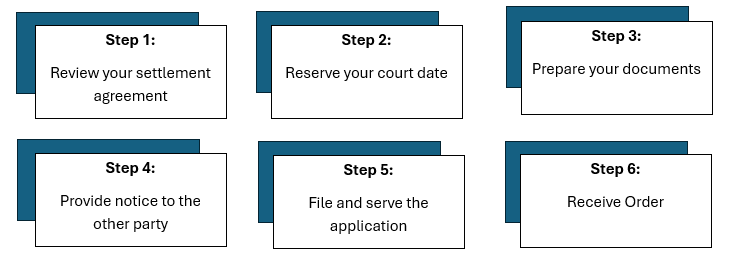 Forms / Templates for Filing: Ex Parte Application, Memorandum of Points and Authorities, and Declaration.docx Proposed Order.docx Index of Exhibits Template.docx
What is it and how does this guide work?
In an Unlawful Detainer case (Eviction Lawsuit) the parties often enter into a settlement agreement after the case has been filed. If a party violates (defaults) on the settlement agreement (such as if a tenant defaults on payment obligations under the agreement) the landlord may file for a judgment based on the terms of the agreement. This guide is intended for situations involving a settlement agreement for deferred judgment. In these cases, the parties agree that a judgment will be entered into only if the tenant fails to meet the terms of the agreement. The landlord does not initially have a judgment and must take additional steps to obtain one if the tenant does not comply. A stipulation is a voluntary agreement between opposing parties on a relevant issue. Stipulations are made either orally and entered into the court minutes or submitted in writing and filed with the clerk. This guide assumes that a written stipulation has been filed with the clerk. If your stipulation was made orally, you will need to adjust the templates accordingly. An Entry of Judgment Pursuant to Stipulation is used when the parties reach a settlement after the case has been filed and enter a stipulation with the court (CCP § 664.6; CRC 3.1385).
Review Your Settlement Agreement
It’s important to review your settlement agreement to confirm that the tenant has really defaulted on the agreement. Reviewing the agreement also helps you determine if you have any additional notice requirements other than what is required by law that you must make before applying for entry of judgment as well as what you can ask for as part of the judgment when there is a default. WARNING: YOU MUST CONFIRM THAT YOUR SETTLEMENT AGREEMENT ALLOWS A JUDGMENT TO BE ENTERED BY EX PARTE APPLICATION. If your settlement agreement does not, then then you must serve and file a noticed motion at least 16 court days before the hearing (CCP § 1005). If your settlement agreement does not allow you to enforce the stipulation by ex parte application – you can review the Sacramento County Law Library’s guide on Motions in Civil Cases (Motions in Civil Cases)
Ex Parte Application
Checklist
- Reservation Date
- Notice to other party – notice of ex parte hearing was provided no later than 10:00 a.m. the court day before the ex parte appearance or shorter notice provided if in an unlawful detainer proceeding
- Attempt to determine whether the opposing party will appear to oppose application
- Application Requirements
- Case Caption that states the relief requested
- Memorandum of Points and Authorities
- Declaration in support of the application
- Declaration based on personal knowledge of the notice provided to other party regarding the ex parte appearance
- Exhibits (other declaration or documents in support of application)
- Proposed Order
- Service
- If service cannot be completed by 10:00 a.m. on the court day before the hearing – serve copies of moving papers at the hearing
- Proof of Service
- Make copies
- File with the court before the reserved hearing date
Reservation Date
Department Information Ex parte applications are heard in the department to which the case is assigned. In Alameda Superior Court, civil cases are generally assigned to a single judge for all purposes, referred to as a Direct Calendar Judge. (Local Rule 3.120). In Alameda County, Law and motion matters are heard in Department 511 in any case that is not assigned to a judge for all purposes or all pretrial purposes (local rule 3.30 (a)), 3.120). Judges will often write specific rules relevant to their department including how to submit ex parte applications and make reservation dates. You can view department information on the Superior Court of Alameda County Public Portal, eCourt Public Portal 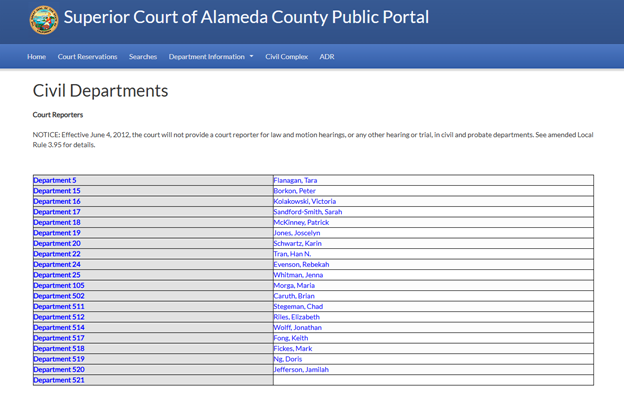
(screenshot of Civil Departments page on eCourt_09.17.2025)
You must reserve a hearing date in Alameda County to present an ex parte application to the court.
Additional Department Requirements- Some departments only hear ex parte matters on specific days.
- To check a department’s calendar, hearing days, or procedures, visit the eCourt Public Portal – Civil Departments page (https://eportal.alameda.courts.ca.gov/?q=node/409). If information is not listed, you may call or email the department directly.
Special Note for Department 511: Before filing a non-emergency ex parte application (i.e. ex parte application for judgment pursuant to a settlement stipulation), parties must email the courtroom clerk at dept511@alameda.courts.ca.gov to have the ex parte scheduled on calendar. The confirmed hearing date must appear in your filed application. All ex parte applications must be filed with instructions for the clerk’s office to route the request to the judge’s work queue. Filings must comply with CRC Rules 3.1201–3.1207 and Local Rule 3.650. You must also give notice of the ex parte request to the opposing party or their counsel. The Court will typically wait 24 hours for any opposition. If the Court determines that a hearing is not necessary, it may rule on the papers.
Notice
Content of notice: All notices must inform the other party of:
- The date, time, and place of the ex parte application; and
- A specific statement of the relief sought.
The person giving notice must also attempt to determine whether anyone will appear to oppose the application. (CRC 3.1204(a)). Method of notice:
- Call the attorney(s) of record, or, if unavailable, their paralegal or secretary. If the other party is unrepresented then call the party directly.
- If no one answers, leave a detailed voicemail with the required contents of the notice.
- Follow up with a fax or email confirming the notice.
Keep a record of who you spoke with, or, if no one was available, the attempts made to make contact and the contents of the voicemail messages. This information must be included in a declaration regarding notice, which becomes part of your application. Note: If notice is inadequate, and no valid reason is provided for failing to give notice, the court may refuse to hear the application. Timing of Notice: Local Rule 3.630 requires the plaintiff/landlord notify the court in writing if possession of the property is no longer an issue because all defendants have vacated the property. Upon such notice the court will issue a Notice of Assignment of the case as a limited or unlimited civil case instead of as an unlawful detainer case. In Unlawful Detainer cases ex parte applications for stays of execution or other extraordinary relief require a declaration showing the following:
- Opposing counsel (or, if there is none on record, the opposing party) has been notified at least 24 hours in advance by telephone or in person of the time of the application.
- The facts that necessitate proceeding ex parte.
- The facts that constitute good cause for a stay of execution.
Minimum best practices: Strive to meet items (1) and (2) above, unless your stipulation sets additional notice requirements (e.g., attempting to give 25+ hours’ notice). In limited or unlimited civil cases the applicant must notify all other parties no later than 10:00 a.m. the court day (this excludes weekends and holidays) before the ex parte appearance. However, a shorter time may be allowed on a showing of exceptional circumstances. (CRC 3.1203(a)).
You can leave the following voicemail:
You can leave the following email if you leave a voicemail and they do not answer:
Preparing Documents
An ex parte application does not include a notice of motion. A separate Proposed Order must be submitted with an ex parte application. (CRC 3.1201) If attaching exhibits, CRC 3.1110(f) specifies the form of exhibits.
- Relevant rules include :
- An index of exhibits must be provided. The index must briefly describe the exhibit and identify the exhibit number or letter and page number (CRC 3.1110(f)(1).
- Each paper exhibit must be separated by a hard 8.5 x 11 sheet with hard paper or plastic tabs extending below the bottom of the page, bearing the exhibit designation (CRC 3.1110(f)(3)).
- eFiled exhibits must be bookmarked (CRC Rule 3.1110(f)(4)).
 Note: Generally, because filings are scanned and uploaded electronically, hard sheets with extended plastic tabs may be impractical for the court to accept. Therefore, if you provide an 8.5 x 11 sheet of printer paper with the appropriate exhibit letter prior to each document, the court is likely to accept the filing despite being out of compliance with rules CRC rules 3.1110(f)(1) and (f)(3). If you still want hard exhibit sheets, the Law Library has a small supply available for sale. The requirement for an index of exhibits is also unlikely to be enforced for law and motion matters. However, if you need an index of exhibits, you can use the following template: Index of Exhibits Template
Templates
Use these sample templates to draft your own motion. Read each document carefully and tailor it to your own situation. Ex Parte Application, Memorandum of Points and Authorities, and Declaration.docx Proposed Order.docx
File and Serve Ex Parte Application and Deliver Courtesy Copy to Assigned Department
Make 4 Copies
- File one copy
- Serve one copy
- Provide a courtesy copy to the clerk
- Keep one copy for yourself
Filing
Check with the individual department to determine the deadline for filing the application. In person filing locations (file only with the court where your judge’s department is): René C. Davidson Courthouse, Room 109, 1225 Fallon Street, Oakland, California 94612 OR Office of the civil clerk located at the Hayward Hall of Justice, 24405 Amador Street, Hayward, California 94544. E-filing information: Civil e-Filing | Superior Court of California | County of Alameda
Courtesy Copy Requirements
An identical courtesy copy of the application must be delivered to the courtroom clerk assigned to the Department where the application will be heard. For matters where the hearing will be two court days or fewer from filing, the courtesy copies shall be delivered the same day as filing. Regular motions are to be delivered by noon the court day after the paper is filed (Local Rule, 3.30(c)). Special Note for Department 511: A hard courtesy copy of any motion must be delivered to Department 511 (in the drop box outside of the department on the 2nd floor) no later than 12:00 p.m. the day after they are filed and served. (Local Rule 3.30(c).) For motions set for hearing on a shortened time schedule (motions not filed at least 16 court days prior to the hearing), delivery may be accomplished by either mailing or hand-delivering the copies to the box outside of Department 511, so long as the courtesy copies are received at least one week prior to the scheduled hearing.
Filing Fees
A fee waiver waives fees related to filing papers in superior court. If you have already filed a fee waiver in your case, you do not need to file another one as fee waivers expire 60 days after your case is finished (judgment entered, dismissal, or final decision by judge). They can also end if the court finds you no longer qualify for the fee waiver. Read more about the fee waivers on Form FW-001-INFO. See the court’s current fee schedule. The 2025 filing fee for an ex parte application requiring a party to give notice of the ex parte appearance to other parties is $60 (GC 70617(a)).
Service
Note: Check the settlement agreement for any provisions that outline how this type of application can be served. You must serve your ex parte application on all other parties who are involved in the case at the first reasonable opportunity. Except in rare situations, the court will not hold the hearing unless service has been made (CRC 3.1206). Note: Serving the papers at the hearing is usually acceptable. However, if you prepared the application well before the hearing and waited until the hearing to serve it, the court may deny your request (Civil Procedure Before Trial §13.12 F.) If you have time before the hearing, you should personally serve the application on the other parties. If you do not have enough time, bring extra copies to the hearing so you can serve anyone who appears. Proof of Service If time permits for service before the hearing, proof of service should be filed with the court Proof of service should be made on a Judicial Council form whenever possible (CCP §417.10(f)).
Attend Hearing
The Court may rule on the papers if the Court deems a hearing unnecessary. Check with the assigned department to determine whether the judge provides information regarding ruling on the papers alone for ex parte applications. An applicant for an ex parte order must appear, either in person or remotely under CRC 3.672, except in some cases that are outlined in the rule. Remote and telephone appearance requirements: See department information, CRC 3.670 – Telephone appearance, and CRC 3.672 – Remote proceedings for guidance. Page 95 of Civil Procedures–Counter to Courtroom can provide a helpful overview.
Collecting Your Judgment
See the Alameda County Law Library’s Quick Resource Guide on Collecting/Enforcing a Judgment: https://lawlibrary.alamedacountyca.gov/project/debt-collection-quick-resource-guide/ For additional information on taking possession of the property, see the Alameda County Law Library’s Quick Resource Guide on Evicting a Tenant: https://lawlibrary.alamedacountyca.gov/project/eviction-for-landlords-quick-resource-guide/ The Alameda County Sheriff’s Office Civil Section is located at the René C. Davidson Courthouse 1225 Fallon Street Room 104 Oakland, CA 94612 Phone:(510) 272-6910
Additional Resources at the Law Library
- Litigation by the numbers, § 6.4 Ex parte Applications, Reference Desk (KFC995 .A65 G78 2003)
- California civil procedure before trial, Chapter 13 Ex Parte Motions and Orders to Show Cause, CA Collection 1st Floor (KFC995 .C35 2004) or electronically via the OnLAW database
- California Forms of Pleading and Practice, Volume 27, Chapter 318 Judgments, CA Collection 1st Floor (KFC1010 .A65 C3) or electronically via Lexis Advance or LexisNexis Digital Library
- California Points and authorities, Volume 13, 131.21 Supporting Motion for Entry of Judgment Pursuant to Terms of Stipulated Settlement [Code Civ. Proc. § 664.6], CA Collection 1st Floor (KFC1010 .B46) or electronically via Lexis Advance
- Civil Procedures: Counter to Courtroom, Self Help Stack 108B (KFC995 .C68) or electronically via California Courts: https://www2.courtinfo.ca.gov/cjer/707.htm
Recent Comments