
Definitions:
-
- Defendant: person responding to a summons and complaint
- Plaintiff: person who filed the complaint and started the lawsuit
- Stipulation: A voluntary agreement between opposing parties concerning some relevant point.
- Default: When a defendant fails to respond in time to a Summons and Complaint, the Plaintiff may request a default from the Court Clerk and prevent the defendant from providing an answer.
Forms / Templates for Filing:
-
- Template Stipulation to extend time to answer.docx (Word doc)
- Ex Parte Application for Extension of Time to Serve Pleading and Orders (CM-020)
- Additional Page [to be attached to any form] (MC-020)
- Request to Waive Court Fees (FW-001)
- Proof of Service by First-Class Mail—Civil (Proof of Service)/Information Sheet for Proof of Service by First-Class Mail—Civil (POS-030)
What is it?
In a civil lawsuit you typically have 30 days from when you were served the Summons and Complaint to provide a response (see: Decide what to do if you’re sued, for more information). The 30-day period is computed by excluding the first day and including the last (unless it is a weekend or holiday and then it is also excluded) (Code of Civil procedure (CCP) § 12).
If you don’t respond in time, there is a risk that the other party can ask for a default and default judgement.
This guide will walk through the different options you have to ask for more time to provide a response and avoid the risk of entry of default.
What Constitutes a Response?
Defendant’s filing of any of the following will prevent the plaintiff from being allowed to obtain an entry of default, even if defendant files late:
-
- Answer
- Demurrer (even if to only one of several causes of action). (CCP § 585; California Rules of Court (CRC) 3.1320(b))
- Motion to strike. (CCP § 435(b)(1))
- When the action has been filed in the improper court, the defendant may make a Motion to transfer action to proper court (CCP § 396b)
- Motion to quash service of summons. (CCP § 418.10(a)(1))
- Motion to stay or dismiss action for inconvenient forum. (CCP § 418.10(a)(2))
- Motion to dismiss for failure to serve summons or for delay in bringing action to trial. (CCP § 418.10(a)(3))
- Petition to compel arbitration where the complaint is based on a contract providing for arbitration. (CCP § 1281.7)
- Comparable motions or pleadings on removal to federal court. [Laguna Village, Inc. v. Laborers Int’l Union (1983) 35 C3d 174, 182, 197 CR 99, 104]
- Potentially, an anti-SLAPP motion (if filed within the time allowed to respond to the complaint) should prevent entry of default, though there is no known case in point. (CCP § 425.16)
Asking For More Time
Make any request for an extension PRIOR to your response deadline*
* If you’ve missed the deadline to respond, you may still file an answer or other responsive pleading as long as a default hasn’t been entered. Refer to the list above for filings that can prevent a default entry by the plaintiff.
Ways to Ask for More Time
-
- Stipulation with plaintiff’s counsel
Limited to 15 days without a court order California Government Code (Govt C) § 68616(b) - Court Order
Limited to 30 days without adverse party’s consent—CCP § 1054. If the parties stipulate to extend the deadline, that time does not count toward the 30-day limit on extensions that the court or judge can grant. (CCP § 1054(b)).
- Stipulation with plaintiff’s counsel
Option 1: Ask the other party to extend the time to file an answer:
Before you begin:
-
- The parties may stipulate without leave of court to one 15-day extension of the 30-day time period (CRC 3.110(d); Govt C § 68616(b))* Please note: this option is not applicable to unlawful detainer, family law proceedings, or proceedings with different service requirements prescribed by law.
- Parties may not stipulate to more than one 15-day extension of time to plead without court order and any additional extension of time to plead must be granted by the Court.
- Without Leave of Court means that there is no need to ask the court for permission. [(Govt C § 68616)
- For complex cases a stipulation for an extension of time for the filing and service of documents always requires approval of the assigned judge (CRC 3.503).
If you talk to the plaintiff / plaintiff’s attorney*, and the plaintiff agrees to an extension, put the agreement in writing and send it to the other party and their lawyer (this can be an email). *Note: If the plaintiff has an attorney, you MUST speak to the attorney
You can use the following template: Template Letter Confirming Time Extension.docx
-
-
- When using this template, please replace brackets [ ] with information relevant to your case.
-
Sample Letter Confirming Time Extension
September 23, 20xx
John Tweedle, Esq.
Tweedle, Dee & Dum
405 14th Street Oakland, California 97001
Re: Solomon vs. Sucherman, Case # 890 765
Dear Mr. Tweedle: This letter confirms our phone conversation today, in which you agreed that I may have until October 19, 20xx to answer or otherwise plead in this case. If you believe this not our agreement, please contact me immediately.
Sincerely,
Monica Sucherman
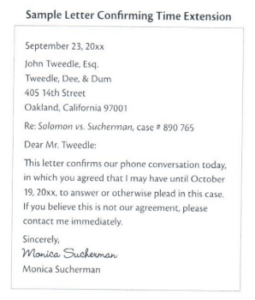 [From Win Your Lawsuit: Sue in California Superior Court Without a Lawyer (Nolo, 2010), Chapter 8]
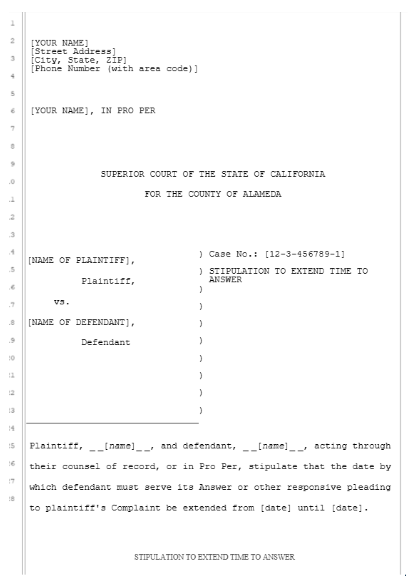
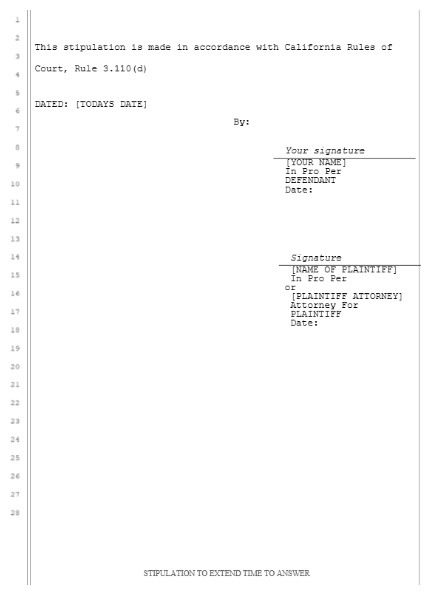
Linked is a template stipulation that should be signed by both parties and filed with the court clerk:
-
- When using this template, please replace brackets [] with information relevant to your case
-
- There is no filing fee for a stipulation that does not require an order (Gov.C. § 70617(b)(5))
View: Alameda County Superior Court Current Fee Schedules
Stipulations typically between parties are only binding if they are in writing AND filed with the clerk; or entered in the court minutes (CCP § 283). Therefore, it’s important that if you get a written or oral agreement from the other party, you should ensure that it is filed with the court clerk.
Template Stipulation to extend time to answer
You may file the stipulation at either of the following locations for civil cases (see Super. Ct. Alameda County, Local Rules (Local Rule) 1.9(d)–(i)), but you will want to file in the court where the original lawsuit was submitted:
The René C. Davidson Courthouse
Room 109
1225 Fallon Street
Oakland, CA 94612
The Hayward Hall of Justice
Office of the Civil Clerk 2
4405 Amador Street
Hayward, CA 94544
View the Superior Court of Alameda County Court Locations & Contact Information page for more information about specific courthouse locations and business hours.
Copies:
- Original (after attorneys have signed, file with court clerk).
- Provide a copy to each party.
- Formal service is not required, but it’s best practice to ensure that each party has a final copy of the stipulation for their records.
A 15-day stipulation to extend is very likely to be granted by attorneys. Judges generally expect counsel to grant a request for extension within the 15-day limitation imposed by Gov.C. § 68616, as courts will typically approve an ex parte application if one is made.
Option 2: Receive a court order to extend time to file a response:
The court can give more time to respond to a complaint, either on its own or on a party’s application.
To get more time to serve a responsive pleading, you must file the request before the current response deadline passes. The request must include a declaration explaining why service hasn’t been completed, what efforts have been made to serve, and the date you plan to complete service. (CRC 3.110(e)).
Judicial Council Form CM-020 (Ex Parte Application for Extension of Time to Serve Pleading) is an optional form that can be used.
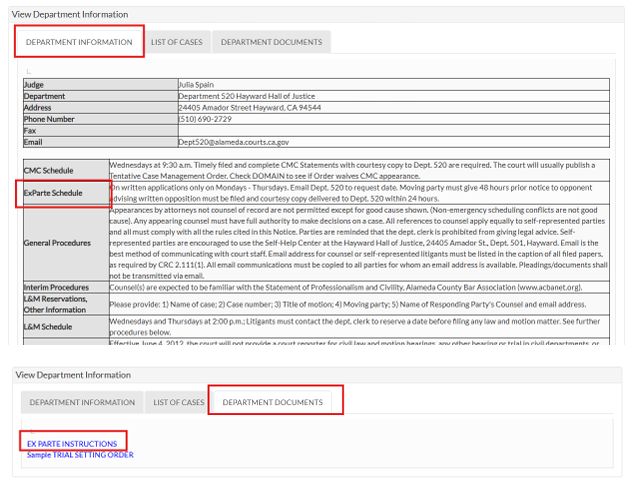
Review your Department Information on eCourt for guidance on how to submit ex parte applications.
- When reviewing department information review both the tabs titled “Department Information” and “Department Documents” to ensure you are reviewing all material provided by the judge.
- Not every department will provide additional documents.
Notice
A party making an ex parte application for an order must notify all parties no later than 10:00 a.m. the court day before the ex parte appearance, absent a showing of exceptional circumstances [CRC 3.1203(a)]*. The Notice provided to the other party must:
- specifically state the nature of the relief to be requested and the
date, time, and place for the presentation of the application; - attempt to determine whether the opposing party will appear to
oppose the application [CRC 3.1204(a)].
(There are different notice requirements in unlawful detainer cases.)
This means that by 10 a.m. the day before you submit your application for an extension of time to plead, you should notify the other party that you will be making this request of the court.
If possible, attempt to provide notice in multiple ways by calling the other party and sending an email. Best practice is making a phone call to the attorney of record for the plaintiff. If they do not answer, leave a message providing all the information required by CRC 3.1204(a) and follow up via email with the same information provided in the voicemail.
You can leave the following voicemail:
You can leave the following email if you leave a voicemail and they do not answer:
Respectfully, ____[your name]_________
Keep track of all attempts you have made to provide the other party notice of the application as you will be required to make a declaration to the court regarding your attempts to give notice.
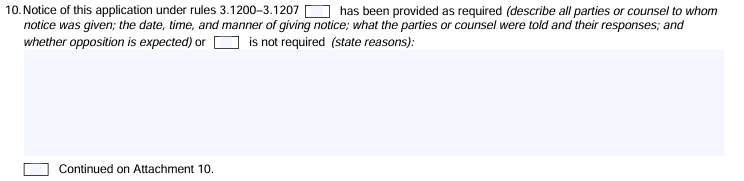
Image: section 10 of Judicial Council Form CM-020 requiring information about what notice was provided.
Form CM-020 – section 10 – provides a declaration section that satisfies the requirement of CRC 3.1204(b) which requires that an application requesting an extension of time to serve pleadings must be accompanied by an affidavit or by declaration establishing one of the following:
- The applicant notified the opposing party of the time and place of the application within the required timeframe of CRC 3.1203 (i.e. 10 am the court day before the ex parte appearance); or
- The applicant made a good faith effort to notify the opposing party but was unable to do so, and detailed the steps taken; or
- The applicant has provided reasons why notifying the opposing party should not be required in this instance.
Shorter notice in civil cases: If notice was provided later than 10:00 a.m. the court day before the ex parte appearance, the declaration regarding notice must explain the exceptional circumstances that justify the shorter notice (CRC 3.1204).
- Note: Even if someone doesn’t follow CRC 3.1203, the clerk must still file the ex parte application and quickly give it to the right judicial officer to review.
How to fill out form CM-020
When you prepare your own forms, be sure to provide facts and information that correspond with your situation.
Court forms can be found from the Judicial Council of California.
- Ex Parte Application for Extension of Time to Serve Pleading and Orders (CM-020)
- Additional Page [to be attached to any form] (MC-020)
Potential reasons for why you need more time to file a responsive pleading:
- You cannot afford to hire an attorney and are representing yourself – you are requesting additional time to complete the necessary work.
- Discussions with insurance company about if it will defend you.
- You have been in discussions with attorneys but are still looking for representation for your case.
- There are complex factual and legal issues which require more time to review and respond.
Amount of time to ask for:
Do not seek an extension beyond 30 days on an ex parte basis (CCP §1054(a)). An order providing for an extension beyond 30 days without the consent of the other party will be considered void (Kennedy v. Mulligan (1902) 136 Cal. 556, 557, 69 P. 29).
Sample:
You can view the Judicial Directory and Assignments for a list of current judicial officers per court location and department: Judicial Directory and Assignments | Superior Court of California | County of Alameda
Filings and Fees
Copies:
- Make 3 copies
- Provide one copy to the court clerk and keep at least one copy for yourself
- You will serve the third copy
Courtesy Copies:
Typically, an identical courtesy copy of any paper submitted in connection with an application must be delivered to the courtroom clerk assigned to the Department in which the application will be heard. For regular motions, such delivery must be made by noon the court day after the paper is filed (Alameda County Local Rule 3.30(c)). Since this type of application does not require a hearing, a courtesy copy may not be necessary.
Filing:
- Ensure pages are single sided when making a paper filing with the court (CRC 2.102)
• In Alameda County Superior Court, civil cases are generally assigned to a single judge for all purposes. Filings for ex parte applications are generally made to the department to which the case is assigned.- For cases not assigned to a single judge for all purposes, ex parte applications are heard in Department 511
Where to file hard copies:
You may file the application at either of the following locations for civil cases (see Local Rule 1.9(d)–(i)) but you should generally file hardcopies in the court where your judge’s department is located:
The René C. Davidson Courthouse
Room 109
1225 Fallon Street
Oakland, CA 94612
The Hayward Hall of Justice
Office of the Civil Clerk 2
4405 Amador Street
Hayward, CA 94544
Note: If filing by mail or drop box, you may obtain file-endorsed copies by providing a postage-paid, self-addressed envelope with the filing (Local Rule1.9(i))
Order
An applicant for an ex parte order must appear, either in person or remotely under CRC rule 3.672, except in the certain cases including applications for extensions of time to serve pleadings. Therefore, the judge will rule on the papers alone.
On the bottom of the application you will see an order section that the judge will fill and sign ordering when the answer needs to be served. A picture is provided below as an example:
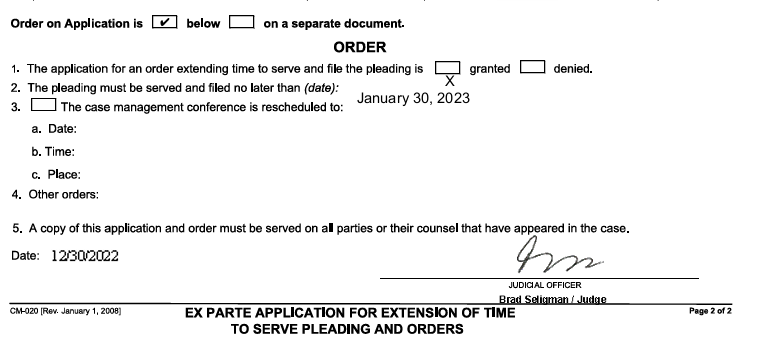
The Officer/Clerk of the Court will serve the order, but you can also view the status of the Order through the Alameda County Superior Court eCourt Public Portal.
Instructions to make an eCourt account:
- Instructions: https://eportal.alameda.courts.ca.gov/sites/default/files/PublicPortalJobAidJan2022v2.pdf
- Video: https://youtu.be/yLRxBUZvdQ0
An order extending time, must be filed immediately and served within 24 hours or within such other time as may be fixed by the court (CRC 2.20(c))
Filing Fees:
- There is a $60 fee for filing an ex parte application that requires a party to give notice of the ex parte appearance to other parties (Gov.C. § 70617(a))
Fee waiver:
Information on asking for a fee waiver: Ask for a Fee Waiver | California Courts | Self Help Guide
The East Bay Community Law Center has a helpful guide to filling out a fee waiver. Fee-Waiver-FW001-Guide_ENGLISH.pdf [Please note that the fee mentioned in the guide is not for ex parte applications.]
You may file a fee waiver with the application.
Additional information about Ex-Parte Applications:
An ex parte application usually needs a supporting memorandum (see CRC 3.1201(4)), but if you use the Judicial Council form, you don’t have to include one (CRC 3.1114(a)(2)).
An ex parte request to extend time to serve a pleading also does not require the applicant to appear for an ex parte hearing (CRC 3.1207(2)).
A reservation date through eCourt is only required for applications that require a hearing (Rulings on Motions | Superior Court of California | County of Alameda).
For parties appearing at an ex parte hearing, the parties must serve the ex parte application or any written opposition on all other appearing parties at the first reasonable opportunity. Absent exceptional circumstances, no hearing may be conducted unless such service has been made (CRC 3.1206).
Updated 11.4.2026
Recent Comments